
Oral · Photo questions
Photo questions in the PSLE Oral: what to say about the picture
The first question is almost always about the photo. Here is how to use the preparation time, the three kinds of photo question, and what turns a description into an answer.

On this page 8 sections
Key takeaways
- In both 2025 and 2026, candidates reported that the first question was about the photo, asking for a judgement, not just a description.
- Use the preparation time for SPF: Surroundings, People, Feelings, and what each one tells you.
- The key move is from “I can see…” to “…which tells me…”. Observation earns little; inference earns the marks.
- Keep the personal example short. On a photo question, the photo should stay the focus.
Why the photo question matters
The Stimulus-Based Conversation starts with a photograph, and in recent years candidates have reported that the first question was about that photo: is this a good place to sell ice cream, would these people enjoy eating here, is this a good place to spend your free time, are these passengers comfortable.
Notice that none of those questions is “describe the picture”. Each one asks for a judgement. The photo is evidence your child uses to support it. That is the skill this guide is about.
SPF: using the preparation time well
Your child gets a short preparation time before the Oral starts. Many children spend it staring at the photo and hoping. We teach them to run through three letters instead:
- SSurroundingsWhere is this? What tells you so?“a park path, trees, flats behind”
- PPeopleWho are they? What are they doing?“a father and daughter, a bicycle”
- FFeelingsHow do they feel? How can you tell?“focused, a little unsure, supported”
- +So what?What does each clue tell you? This is where the answer comes from.“…which tells me…”
Here is SPF on the photo at the top of this page, the way a student might jot it down:
| Step | What I can see | What it tells me |
|---|---|---|
| Surroundings | A paved park path, trees, a block of flats behind, a shared bicycle | A neighbourhood park, close to home, an everyday weekend scene |
| People | A girl pedalling, her father holding the bicycle and running alongside | She is learning to ride, and he is helping her |
| Feelings | The girl is looking down, concentrating; the father is close and steady | She is focused and perhaps a little nervous; he is patient and supportive |
That is a little quiet thinking turned into a ready answer: “I think the girl is learning to ride a bicycle with her father’s help. Firstly… Secondly… For example…”.
Three kinds of photo question
Type 1 · What is happening?
“What do you think the people in the picture are doing?”
Start with: “In this picture, I think… Here are my reasons why.” Then use Surroundings and People as your two reasons.
Type 2 · How do they feel?
“How do you think the boy is feeling?” or “Are the people comfortable?”
Start with: the feeling, then prove it with faces, posture and what people are doing. The F in SPF carries the answer.
Type 3 · Is this a good place to…?
“Is this a good place to spend your free time / sell ice cream?”
Start with: your judgement, then two features in the photo that support it, each explained.
Tutor feedback: a Type 1 question, three levels
This question and photo come from our AI oral practice. The weaker and middle answers are illustrative, written by our tutors; the stronger answer is the app’s model answer.
Practice question
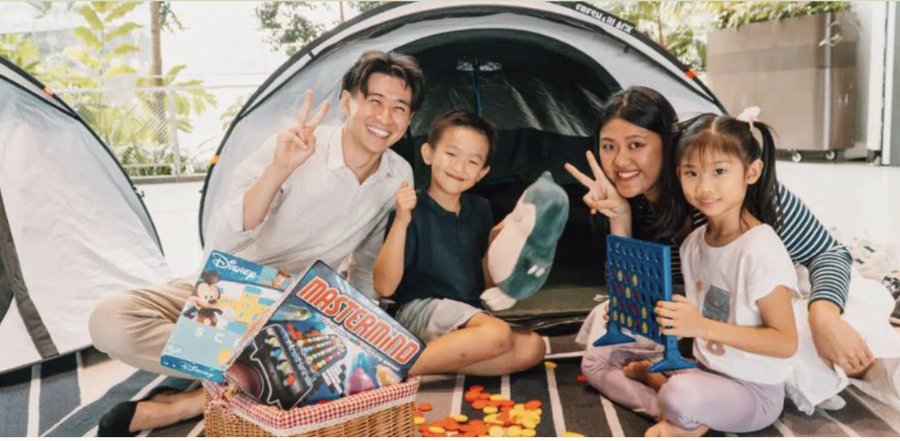
Look at the picture. What do you think the family is doing together?
Type: what is happening.
Highlighted: earns creditUnderlined: loses marks
They are playing a game. They are in a tent. They are smiling.
- What works
- Three accurate observations.
- What loses marks
- It is a description, not an answer. Nothing says what the details mean, and there is no opinion, example or ending.
- The one fix
- Start with a judgement (“I think the family is camping and…”), then use the details as reasons.
I think the family is camping and playing a board game together. I can see a tent and everyone is smiling. I also like camping. It is very fun.
- What works
- A clear judgement up front, supported by what is visible.
- What loses marks
- The details are named but not explained (what does the smiling tell us?). The personal line is a general statement, not a moment, and “very fun” has no reason.
- The one fix
- Turn each detail into a reason with “which tells me…”, and make the example one real moment.
- PPoint
In this picture, I think the family is enjoying a camping trip together and playing a board game. Here are my reasons why.
- EExplain · surroundings
Firstly, I can see a tent set up in the background, with the family seated on a picnic mat in front of it. This tells me that they are most likely camping outdoors, perhaps at a park or campsite. There are four family members in the picture, and they appear to be gathered closely around a board game placed on the mat.
- EExplain · feelings
Secondly, everyone in the picture has a smile on their face. This shows me that they are enjoying each other’s company and having a great time together. Playing a board game as a family is a wonderful way to bond and spend quality time with one another, away from their phones and daily busy schedules.
- EExample
For example, my family also enjoys playing board games together, especially during the weekends. We usually play games like Monopoly or Uno after dinner on Saturdays. I feel very HAPPY during these moments, as it is a rare chance for all of us to sit together and laugh over silly mistakes made during the game.
- LLink
In conclusion, I can see that the family in the picture is spending quality time together, enjoying a game while camping outdoors.
- How SPF and PEEL work together
- SPF produced the two reasons: the first Explain uses Surroundings and People (tent, mat, four family members), the second uses Feelings (smiles). Each one ends with what it shows: “This tells me…”, “This shows me…”. PEEL then gives the answer its order and its ending.
- Make it your own
- The family’s board game night should be your child’s own. If you do not play board games, any real family moment will do.
A Type 2 question: how is he feeling?
Feelings questions use the same structure, with the F of SPF doing most of the work. This model answer from our app is about a photo of a boy at his desk, holding up an exam paper he has failed.
- PPoint
In this picture, I think the boy is feeling sad and disappointed. Here are my reasons why.
- EExplain · situation
Firstly, I can see that the boy is seated at a desk, holding up an exam paper that shows he has failed. This tells me that he is likely in a classroom setting, and has just received his exam results.
- EExplain · expression
Secondly, the boy has a sad expression on his face, which suggests that he is upset about his results. This is a natural reaction, as many students feel disappointed in themselves after not performing as well as they had hoped, especially if they had put in effort while studying.
- EExample
For example, I have also felt disappointed before after not doing well for a test, despite studying hard for it. I remember feeling quite DOWN for the rest of that day, though I eventually reminded myself that one test result does not define my abilities.
- LLink
In conclusion, I can see that the boy in the picture is feeling sad and disappointed about failing his exam.
- What to notice
- Two feelings are named straight away, then each reason explains why he would feel that way. The example shows empathy and ends on a mature reflection, without turning the answer into a story about the speaker.
Common mistakes, and how to spot them at home
| What you hear | What it usually means | What to try |
|---|---|---|
| A list of everything in the photo | Describing instead of answering. | “What’s your answer in one sentence? Now give me two clues.” |
| “They are happy.” Full stop. | A feeling with no proof. | “How can you tell?” until your child points to faces, posture or actions. |
| A long story about your child’s own camp | The photo has been forgotten. | Keep the example to three or four sentences, then come back to the photo. |
| Guessing wildly beyond the photo | Inference without evidence. | “Which part of the photo tells you that?” If nothing does, leave it out. |
Try this at home: photo of the day
Try this at home · 10 minutes
Photo of the day
- 0:00Pick any photo of people from your phone or the news: a queue, a park, a void deck, a family meal.
- 1:00Give your child two minutes of silent preparation. They say S, P and F to themselves, with one “so what?” each.
- 3:00Ask a Type 1 question: “What do you think is happening here?” Listen for “which tells me”.
- 5:00Ask a Type 2 question about the same photo: “How do you think they feel?”
- 8:00One compliment, one fix. Save the photo; it makes a good revision deck.
Tonight’s prompt
Show the cycling photo at the top of this page and ask: “Do you think the girl will learn to ride well? Why?”
Questions parents ask
What if my child cannot tell what is happening in the photo?
Teach them to say what they think and why: “I think they are…, because I can see…”. Examiners are asking for a reasonable interpretation backed by evidence, not a single correct answer.
Should my child describe everything in the photo?
No. Two or three details that support the answer are better than a list of everything visible. Each detail should lead to a point.
Will the photo be in colour?
We cannot confirm how photos will be printed in any given year, and candidates’ reports have varied. Practise with both colour and black-and-white photos, so your child relies on what people are doing rather than on colours.
Mustard Seed is an independent tuition provider and is not affiliated with or endorsed by SEAB, MOE or Cambridge Assessment. No tutor can guarantee a particular grade.


