
Parent Guides · Our app
How our AI practice app works: a walkthrough for parents
What your child actually does in our app, screen by screen: speaking out loud for the Oral, Paper 2 and Listening practice, the feedback after each attempt, and what you can see as a parent.

On this page 7 sections
Key takeaways
- The app covers three of the four PSLE English papers: the Oral, parts of Paper 2, and Listening Comprehension.
- For the Oral, your child speaks out loud and gets a mark, written feedback and a model answer after each answer, with a chance to try again.
- Paper 2 and Listening practice is marked straight away, with an explanation for each mistake.
- You can see progress over time, a weekly goal and a summary written for parents.
- You can start with one Oral practice and no account. A free account adds two more, plus free Paper 2 practice and the first Listening set.
What the app covers
Parents often ask what their child will actually do in our app before they sign up. This page walks through it, screen by screen, so you can judge for yourself whether it suits your child.
| Part of PSLE English | In the app | How it is marked |
|---|---|---|
| Oral (Paper 4) | Reading Aloud and picture-based conversation topics, plus a mock oral in exam format | Reading Aloud from the audio; conversation answers from a transcript, by AI, against our tutors’ marking guide |
| Paper 2 | Grammar, Vocabulary, and Synthesis and Transformation, at P4, P5 and P6 level | Automatically, against answers written by our tutors |
| Listening (Paper 3) | Recorded passages with multiple-choice questions, and a Mock LC Practice | Automatically, against answers written by our tutors |
The topics, passages, questions and model answers are all written by Mustard Seed English Class. The app does not cover Paper 1 (Writing).
Oral practice, step by step
1. Choose a topic or a mock oral
Your child picks a topic to practise, or a full mock oral in exam format: five minutes to prepare, Reading Aloud with a given situation, then a conversation about a photograph with three questions on different themes.
2. Read aloud
The passage starts with a short situation, just as in the exam. Your child reads it aloud, and the reading is assessed from the audio for accuracy, fluency, completeness and expression, out of 15.
3. Talk about the photograph

Your child sees a photograph and answers questions about it out loud, moving from the picture to their own experiences and opinions, like the real Stimulus-Based Conversation.
4. Feedback after every answer
After each answer, your child sees what they said, written tutor-style feedback, one thing to improve, and a model answer to compare. They can then try the same answer again. The first answer is the one that counts for progress; the second try is extra practice, and the improvement is shown at the end.
The model answers follow the PEEL structure we teach: a Point, an Explanation, an Example and a Link. Our debriefs of PSLE 2026 Day 1 and Day 2 show four of them, broken down step by step.
5. Results for the whole practice

At the end, your child sees a total out of 40, split into Reading Aloud (out of 15) and the conversation (out of 25).

Below the scores is an overall summary: strengths, areas to improve, and a single next step, written for your child to act on.
Paper 2 practice
Your child chooses a level (P4, P5 or P6) and a section: Grammar, Vocabulary, or Synthesis and Transformation (at P5 and P6). A Grammar or Vocabulary session is ten multiple-choice questions. A Synthesis session is five questions, worth 2 marks each, where your child types the complete sentence. Every session is out of 10.

After submitting, your child sees the score and can review every answer: their choice, the correct answer and a short explanation of why. For Synthesis, where more than one answer can be right, the app shows every answer we accept. Questions are drawn from a large bank for each level, so sessions vary.

Paper 2 practice is free with an account. Our guides to every Paper 2 section and to Synthesis and Transformation use examples from the same question bank.
Listening practice
Your child chooses a set and works through its passages. There are nine regular sets, each with six recordings and 20 questions, plus the Mock LC Practice. Each recording can be played at most twice, and every question has three options.

After submitting, your child sees the score straight away. For every question they got wrong, the app shows their answer, the correct answer and our tutor’s explanation.

With a free account, the first Listening set is open with unlimited tries. Full access opens every set and the Mock LC Practice, which draws a new set each time. Our Listening Comprehension guide covers the habits worth practising.
What parents can see
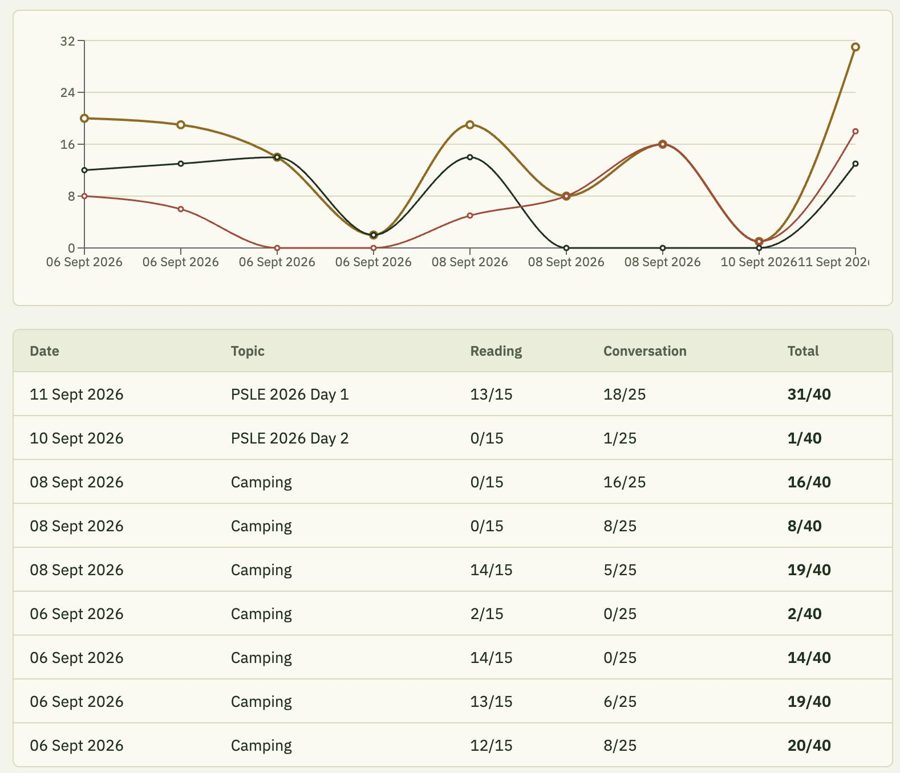
Every practice is logged, so you can see whether scores are trending up. On the dashboard, your child also has:
- A weekly goal for Oral practices, with a count of weeks in a row the goal was met.
- A focus for the week, and words to practise saying, which your child can tap to hear.
- A message to parents: a short summary of the week that your child can send to you.
- Levels, XP and an avatar that changes as they practise, which many children find motivating.
What is free, and what is paid
| Plan | What it includes |
|---|---|
| No account | One Oral practice |
| Free account | Two more Oral practices, Paper 2 practice, and the first Listening set with unlimited tries |
| Monthly, S$19.90 | All Oral topics with no cap on attempts, the mock oral, every Listening set and progress tracking. Renews monthly; cancel any time |
| 1 month, S$19.90 once | The same, for 30 days, with no renewal |
| Exam Pass, S$59.90 once | The same, valid until 31 October 2027, with no renewal |
Paper 2 practice stays free on every plan. Practice marks are guidance, not official PSLE marks. Full plan details are on our AI oral practice page.
Questions parents ask
Is the AI marking the same as PSLE marking?
No. Practice marks are guidance to show progress and what to work on, not official PSLE marks. Our marking follows the same areas the Oral rewards, and the feedback is designed to be acted on.
What does my child need?
A device with a microphone and a quiet room. The app runs in the browser and works best in Chrome or Edge. Headphones help for Listening practice.
Are recordings stored?
For Reading Aloud, the audio is sent for pronunciation analysis and is not stored afterwards. For the conversation, the app works from a transcript of what your child said. Our privacy policy has the details.
Does the app replace a tutor?
It does a different job. The app gives plenty of practice with instant feedback. A tutor can diagnose what is holding a child back and adapt to them. Our honest guide to coaching helps you decide what your child needs.
Mustard Seed is an independent tuition provider and is not affiliated with or endorsed by SEAB, MOE or Cambridge Assessment. No tutor can guarantee a particular grade.


